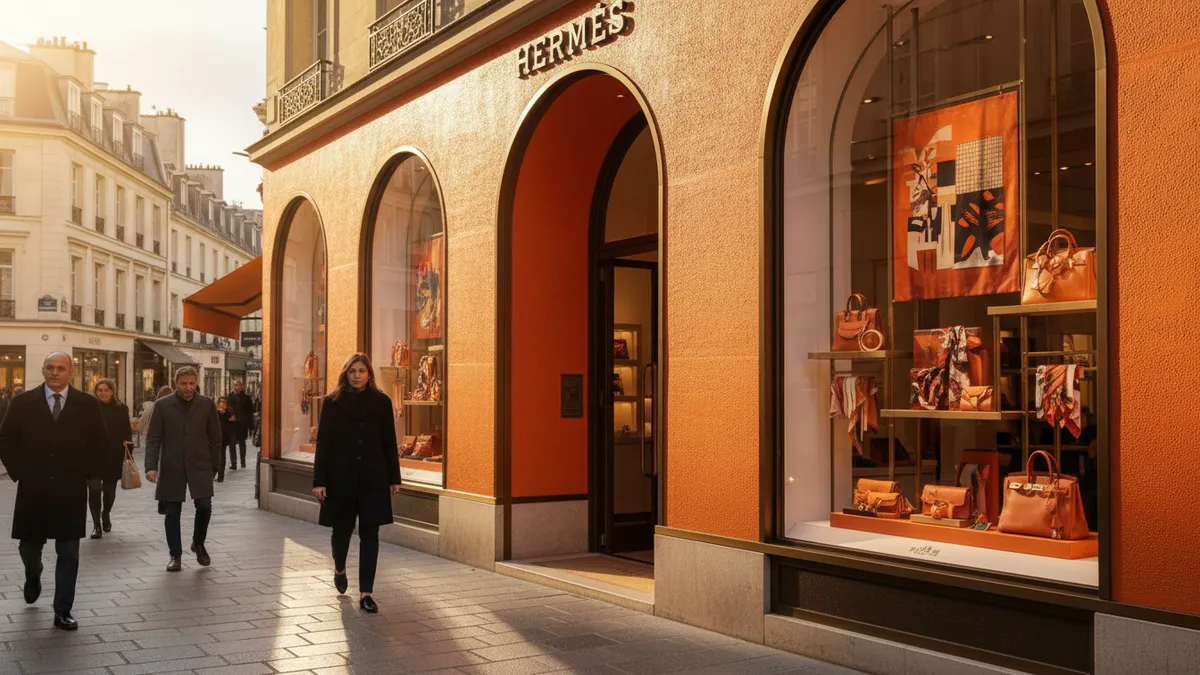
Hermès International reported first-quarter 2026 revenue of €4.1 billion, a 6% increase at constant exchange rates, according to the company’s official first-quarter 2026 revenue statement released April 15. The Americas led all regions with a 17.2% surge, while the Middle East posted a 5.9% decline tied to geopolitical tensions. At current exchange rates, Hermès Q1 2026 revenue dipped 1% due to a €290 million currency headwind from the weakening U.S. dollar against the euro.
Q1 2026 Revenue Overview
The French luxury house beat analyst revenue forecasts by 0.49% but missed earnings-per-share expectations by 7.47%, per Hermès investor relations filings. The gap between constant-currency growth (+6%) and reported growth (-1%) underscores a significant dollar-euro imbalance that pressured results across the company’s international operations.
Executive Chairman Axel Dumas framed the results cautiously in the official statement:
“In a tense geopolitical environment, Hermès maintains its course…with confidence and conviction.” — Axel Dumas, Executive Chairman, Hermès International
Americas and Japan Drive Expansion
The Americas was the standout performer at €739 million, up 17.2% at constant exchange rates. This double-digit growth comes as U.S. retail sales projected to hit $5.6 trillion in 2026, suggesting Hermès is capturing an outsized share of strong domestic consumer spending.
Japan posted €404 million, up 9.6%, while Europe excluding France reached €538 million, gaining 9.7% on solid local demand. All three regions delivered the kind of growth most luxury competitors would envy right now, particularly as LVMH posted its worst Q1 on record during the same period.
Middle East and France Bear Geopolitical Impact
The Other/Middle East region dropped to €160 million, down 5.9% at constant rates. Hermès directly cited geopolitical developments affecting the UAE, Kuwait, Qatar, and Bahrain from March onward. The Qatar Investment Authority’s luxury fashion moves highlight the Gulf’s dual role as both a capital source for luxury brands and a vulnerable consumer market.
France posted €347 million, declining 2.8% as tourist flows from the Middle East slowed sharply in March. Asia-Pacific excluding Japan remained the largest region by revenue at €1,881 million but grew just 2.2%, the slowest rate of any Hermès market.
Division Performance: Leather Goods Lead, Watches Retreat
Leather Goods & Saddlery drove the quarter at €1,849 million, up 9.4%, fueled by what Hermès described as “strong desirability” and expanded production capacity. Silk & Textiles followed at €257 million, up 7.8% across women’s and men’s collections.
The weaker divisions told a different story:
- Ready-to-wear & Accessories: €1,076M, up just 0.4%
- Perfume & Beauty: €127M, up 0.2%
- Watches: €135M, down 3.7% — the only division to post a decline
U.S. Price Increases Planned From May 1 to Offset Tariffs
Hermès will raise U.S. prices by 4-5% across all product categories starting May 1. The increase covers bags, scarves, accessories, watches, and fragrance, and is designed to offset the 10% EU tariff rate on imports.
Bernstein analysts confirmed the price hike “will likely cover for a worst-case scenario of 10 percent tariffs and compensate for the recent weakening of the U.S. dollar against the euro,” per U.S. tariff-driven price increases reporting. The move follows a broader pattern of U.S. fashion prices rising in 2026 as tariffs bite across the industry.
Broader Luxury Market Context
Hermès’s 6% constant-currency growth stands in sharp contrast to LVMH, which reported Q1 revenues fell 5.9% to €19.12 billion with organic growth of just 1%. While several luxury brands struggling with revenue declines are cutting staff and restructuring, Hermès continues investing in production capacity.
The structural challenge is real. Bain & Company data shows the global luxury customer base shrank from 400 million in 2022 to roughly 330-340 million by early 2026. Yet HSBC’s luxury market outlook remains positive, with buy ratings maintained and analysts citing renewed creativity and attractive price points as catalysts for recovery.
Hermès shares, already down more than 20% in Q1 2026, rose 1.27% following today’s release. As L’Oréal’s €4 billion Kering Beauté acquisition and other consolidation moves demonstrate, the luxury landscape is shifting fast. Whether the luxury fashion market rebound in 2026 materializes broadly or stays concentrated in names like Hermès remains the key question heading into the second half.