Levi Strauss & Co. posted first-quarter 2026 net revenues of $1.742 billion, a 14% jump over the year-ago period, the company reported on April 7. The Levi Strauss Q1 2026 earnings beat Wall Street’s consensus estimate of roughly $1.65 billion and pushed adjusted diluted earnings per share to $0.42, well above the $0.37 analysts expected. The results land at a moment when much of the fashion sector is struggling — LVMH posted its worst Q1 on record in 2026 — making Levi’s outperformance all the more notable.
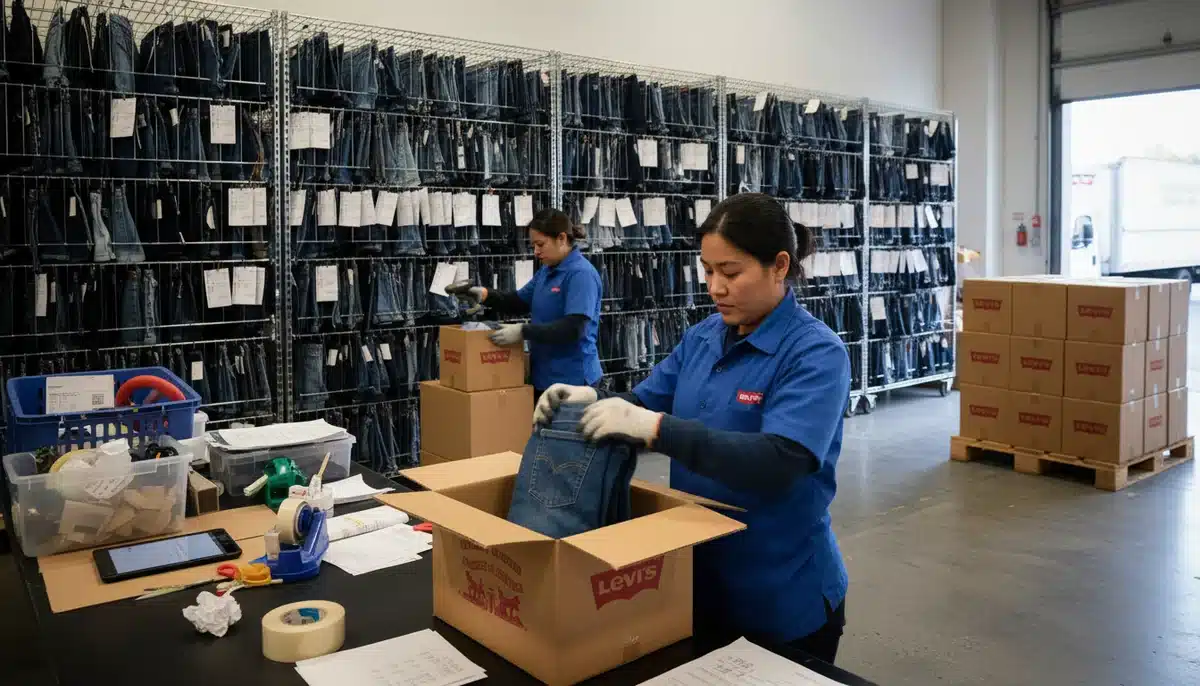
Image: Courtesy of Levi Strauss & Co.
Q1 2026 Financial Results at a Glance
Net income from continuing operations reached $177 million, up 26% from $140 million in Q1 2025. GAAP diluted EPS from continuing operations came in at $0.45 versus $0.35 a year earlier. Gross margin dipped 20 basis points to 61.9%, down from 62.1%, as tariff pressure offset gains from reduced promotions and targeted price increases.
- Net revenues: $1.742B (up 14% reported, 9% organic)
- Adjusted diluted EPS: $0.42 (vs. $0.37 estimate)
- Net income: $177M (up 26% YoY)
- Gross margin: 61.9% (down 20 bps)
Full financial data is available through Levi Strauss & Co. investor relations.
DTC-First Strategy Drives Broad Revenue Growth
Direct-to-consumer sales now account for 52% of total revenues, a milestone CEO Michelle Gass highlighted on the earnings call. DTC net revenues climbed 16% on a reported basis and 10% organically. Comparable DTC store sales rose 7%. E-commerce surged 21% reported and 17% on an organic basis.
“We are becoming a more DTC-first denim lifestyle company, and it is leading to more consistent and faster growth.” — Michelle Gass, CEO, Levi Strauss & Co.
The Beyond Yoga brand delivered 23% growth, emerging as a standout performer. Gass noted that Q1 growth was “driven equally between AUR and units,” suggesting pricing power and genuine demand are both contributing. The company’s multi-year global partnership with Blackpink’s Rosé is part of a broader celebrity strategy aimed at driving consumer engagement, while the denim lifestyle trend driving streetwear crossover in spring 2026 continues to support Levi’s core market positioning.
Regional Performance: Europe Leads With 24% Growth
Europe was the standout region, delivering 24% reported growth and 10% on an organic basis. Asia followed with 13% reported growth (12% organic). The Americas posted 9% reported and 7% organic gains, with the U.S. specifically growing 4%.
Wholesale revenue rose 12% reported and 8% organic, indicating that Levi’s growth is not purely a DTC story. The broad-based gains come as the NRF projects U.S. retail sales to hit $5.6 trillion in 2026, creating a favorable macro backdrop for apparel brands with momentum.
Tariff Headwinds: Guidance Assumes 20% Global Rate
Levi’s current guidance is built on an assumption of 20% global tariffs and 30% on China imports. If tariffs drop to 10% under a potential Supreme Court rollback scenario, the company estimates a full-year EPS benefit of approximately $0.07 per share, or roughly $35 million.
CFO Harmit Singh told analysts: “We expect to fully offset the impact of tariffs through our various mitigation efforts.” CEO Gass added that the company has “not seen an impact on demand” from targeted pricing actions. The approach has been described as “surgical” — selective price increases rather than across-the-board hikes. As we reported, U.S. fashion prices rising 17% in 2026 due to tariffs are pressuring the broader industry, making Levi’s margin management a key differentiator.
Full-Year 2026 Guidance Raised Across All Metrics
Management raised the full-year outlook on every key metric:
- Revenue growth: 5.5%–6.5% (raised from 5%–6%)
- Organic revenue growth: 4.5%–5.5% (raised from 4%–5%)
- Gross margin: Flat to slightly up (raised from flat)
- Adjusted EBIT margin: Approximately 12%
- Adjusted diluted EPS: $1.42–$1.48 (raised from $1.40–$1.46)
Singh described the guidance bump as prudent: “It’s early in the year. We have a sizable beat… our view is to be prudent in the outlook as we think forward.” Analysts have noted the conservatism, with some pointing to upside if tariff conditions ease. HSBC’s 2026 luxury fashion market rebound forecast adds broader sector optimism to Levi’s already-positive trajectory.
CFO Harmit Singh to Retire After 13-Year Tenure
Alongside the earnings release, Levi Strauss announced that Chief Financial & Growth Officer Harmit Singh will retire following a planned transition. Singh has served the company for 13 years and will remain in his role until a successor is named, then transition to a Special Advisor position.
A comprehensive search is underway through a leading executive search firm. No successor has been named as of April 7, 2026. Singh’s departure comes at a pivotal moment — his stewardship helped engineer Levi’s financial turnaround and the DTC pivot that now defines the company’s growth story.
Shareholder Returns Surge 163% Year-Over-Year
Levi Strauss returned $214 million to shareholders in Q1 2026, a 163% increase from the prior-year period. The company launched a $200 million accelerated share repurchase, retiring approximately 8 million shares at a cost of $160 million. The quarterly dividend rose 5% to $0.14 per share.
The aggressive capital return signals management confidence in the company’s cash generation and outlook, even as it navigates tariff uncertainty.
What Comes Next for Levi Strauss
The Q1 beat positions Levi Strauss well heading into the second half of 2026. The DTC-first strategy is delivering measurable results, tariff mitigation appears credible so far, and the CFO transition — while significant — is being handled on a timeline that should minimize disruption. The raised guidance, even in its conservatism, reflects a company with real momentum in an uneven market.
For more coverage of fashion industry earnings and business developments, read our reporting on sustainable fashion gaining traction with major brands and explore our analysis of the 2026 luxury market rebound.
Source: Levi Strauss Q1 2026 press release via BusinessWire.