The Celine silk scarf has become the breakout luxury accessory of 2026. Media impact value for the house’s silk scarves climbed from $221,000 in the pre-show period of Q3 2025 to $1.8 million in Q1 2026, an eight-fold increase, according to industry data published by WWD on May 26. The surge tracks directly to Michael Rider’s July 2025 debut as artistic director, replacing Hedi Slimane after seven years at the house.
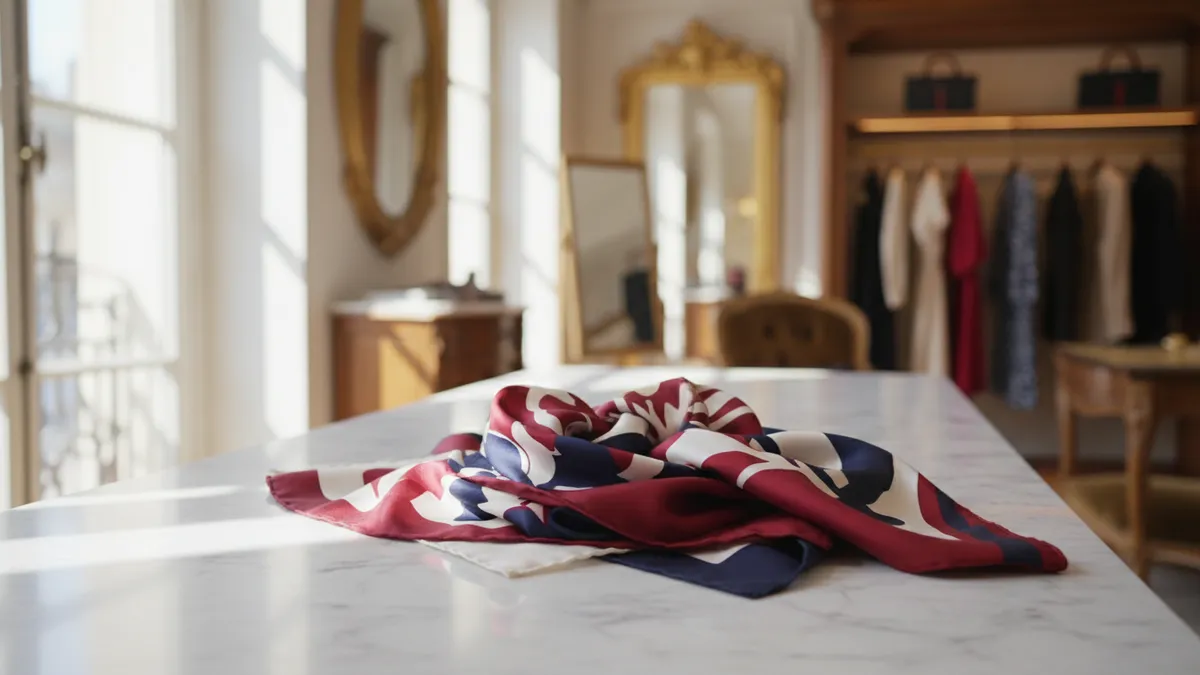
Rider has centered the archival scarf as a signature element of both his collections and his ready-to-wear strategy. The piece, first introduced to the line in 1963, has been positioned as a hero buy across his Spring 2026 and Summer 2026 shows. Michael Rider’s debut at Celine followed a year-long search by LVMH and was confirmed in mid-2024.
Image: Courtesy of Celine
A Heritage Piece, Revived
Céline Vipiana founded the house in Paris in 1945. Silk scarves entered the product line in 1963 and remained a recurring signature through the 1970s. LVMH acquired the brand in 1996.
Rider signaled the scarf’s centrality from his first day. Show invitations for both Spring 2026 and Summer 2026 arrived physically tied in satin Celine scarves, a deliberate styling cue sent to editors and buyers ahead of the runway. At the July 2025 debut at 16 rue Vivienne, an oversized red, white, and blue silk scarf was draped over the courtyard as models walked.
The visual framing was clear before a single look hit the runway: the scarf was the through-line.
From Accessory to Ready-to-Wear Signature
In the Celine Spring 2026 collection, printed satin scarves were singled out by buyers as hero pieces. In the sophomore Summer 2026 collection, scarf prints expanded across categories. The motif appeared on pants, skirts, draped tops, men’s polo shirts, and trenchcoat linings.
Rider addressed the strategy directly. “Scarves are something I wear, and everyone wears differently,” he said. “It’s also something you tend to keep.”
Runway guests demonstrated the point in real time. Editors were photographed wearing the invitation scarves around their necks, looped through belt loops, and knotted onto handbag straps. The styling versatility Rider cited became part of the show’s documentation, amplifying organic social pickup.
Media Impact by the Numbers
The quarterly media impact value progression shows a consistent climb:
- Q3 2025 (pre-debut): $221,000
- Q3 2025 (post-debut): $980,000, a near-threefold jump
- Q4 2025: $1.2 million
- Q1 2026: $1.8 million
The top single post drove $72,000 in MIV from an Elle Taiwan feature. South Korean singer Kim Tae-hyung, known as V of BTS, appeared in the highest-performing social media post tracked in the data set. Lady Gaga, Dakota Johnson, and Natalie Portman have also been photographed in Celine under Rider’s direction since the debut, adding sustained celebrity visibility through the awards and press cycle.
Market Context: Silk Scarves as a Growth Category
Celine’s scarf momentum sits inside a broader category expansion. The global scarves and shawls market was valued at $28.04 billion in 2026 and is projected to reach $56.37 billion by 2034, a 9.12% compound annual growth rate, per Fortune Business Insights. The silk segment is expected to hold 32.6% market share in 2026.
The European luxury scarves market alone hit $2.7 billion in 2025 and is forecast to reach $4.2 billion by 2033 at a 6.4% CAGR. Spring 2026 runways broadly featured silk scarves at Toteme, Dries Van Noten, and Maison Magdalena. Chanel topped the Lyst Index Q1 2026, but Celine’s accessory momentum is now a measured data point in the same competitive set.
The trend connects to broader summer 2026 accessories trends, which include statement jewelry and unconventional bag silhouettes such as the fish-shaped bags trend and the jelly tote bag trend.
Celine is also expanding its U.S. footprint to 36 locations, with new stores in Scottsdale, Arizona, and Florida planned for 2026. The expansion follows LVMH’s portfolio recalibration that included the LVMH’s Marc Jacobs sale to WHP Global earlier this year.
Rider’s Broader Direction at Celine
Industry commentators have framed Rider’s approach as a return to precise, wearable, deeply considered luxury, drawing direct comparisons to the Phoebe Philo era at the house. Monocle described his debut as “a debut free of theatrics but rich in poise.” W Magazine noted the Spring 2026 collection “weaves the house’s past into a new vision for the future.”
Rider’s appointment is part of a wider 2026 creative leadership reshuffle across luxury, including Matthieu Blazy’s debut at Chanel, Jonathan Anderson’s debut at Dior, and Gucci Cruise 2027 under Demna. The scarf revival functions as both a commercial strategy and a creative statement, connecting Celine’s 1963 heritage to 2026 consumer behavior.
For Celine, the data confirms what the runway already telegraphed: the silk scarf is no longer a supporting accessory. It is the lead. Expect the carryover to continue into fall, alongside other signature item moves such as the ruched loafers trend, as luxury houses double down on identifiable, repeat-purchase pieces.