Olive Young, South Korea’s largest beauty retailer, opened its first U.S. store on May 29, 2026 at 58 W. Colorado Blvd. in Pasadena, California, marking the long-anticipated brick-and-mortar debut of a chain that operates more than 1,380 locations across South Korea and posted $4.2 billion in revenue last year. The 8,647-square-foot flagship drew overnight crowds — fans began queuing on Colorado Boulevard as early as 1 a.m. — and arrived as K-beauty sales in the United States hit $2.4 billion over the past 12 months, a 48% year-over-year surge, according to the company’s official press release.
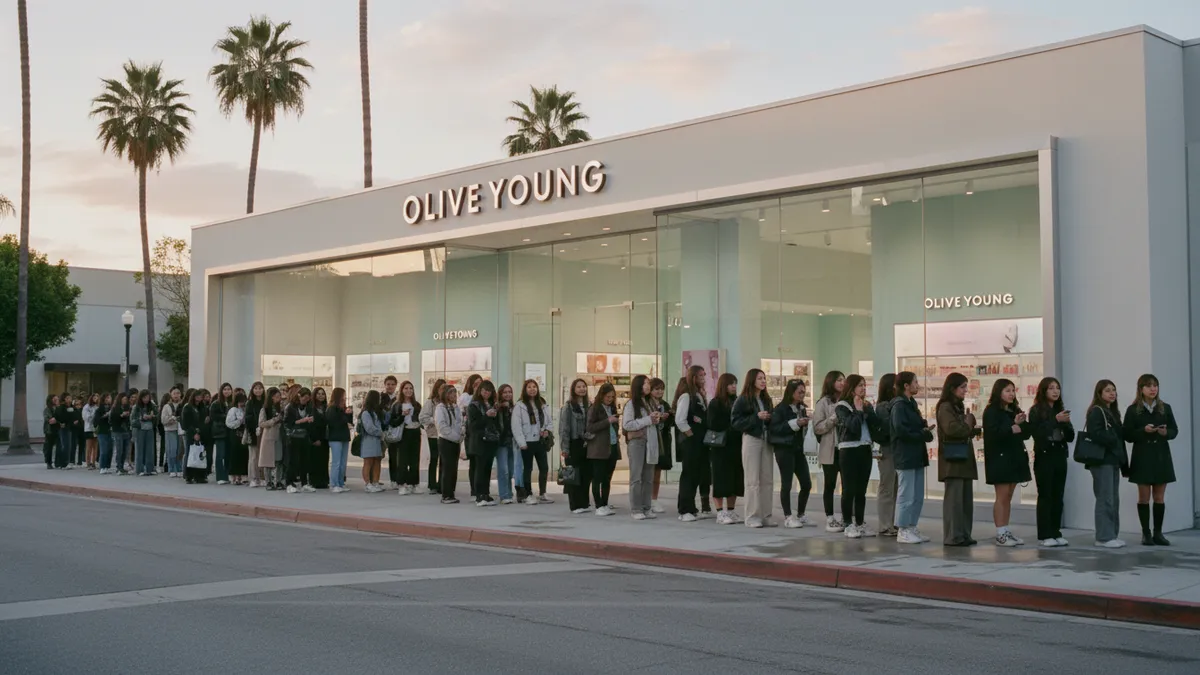
Image: Courtesy of Olive Young
The opening coincided with the launch of a dedicated U.S. e-commerce platform at us.oliveyoung.com, with free shipping on orders over $35 and no additional import duties. Olive Young’s U.S. subsidiary, established in 2025 under parent company CJ Group, has confirmed at least six additional West Coast openings by mid-2027.
Inside the Pasadena Store
The Pasadena flagship stocks approximately 5,000 SKUs from around 400 brands. Featured K-beauty lines include Anua, MEDIHEAL, Biodance, rom&nd, Torriden, Unove, fwee, and Mise-en-scène. International labels sold alongside Korean brands include CeraVe, Kiehl’s, La Roche-Posay, Sol de Janeiro, The Ordinary, and Urban Decay.
Products are organized by skin concern — brightening, hydration, dark spots — rather than by brand, a departure from the Korean store format. A dedicated experiential zone called “The Beauty Lab” offers expert-guided skincare sessions, in-store skin scanning, complimentary scalp analysis, and double cleansing water-basin stations for product testing.
A three-tier loyalty membership — Friend, Green, and Gold — launches in July 2026. The format places Olive Young between Sephora’s brand-organized model and Ulta’s mass-prestige hybrid, with a heavier emphasis on guided discovery.
Opening Day: Fans Camp Overnight
Shoppers began lining up outside the Pasadena store from the early hours of Thursday night, with the queue extending down Colorado Boulevard by daybreak. The turnout was not unexpected: more than 50% of Olive Young’s global e-commerce revenue was already coming from U.S. customers before any physical store launched.
The crowd response echoed other recent beauty retail debuts, including Lisa Eldridge’s SoHo pop-up earlier this spring and the relaunched Marc Jacobs Beauty distribution rollout in May.
“The U.S. is the biggest market in terms of trend and influence. K-beauty has become more than just a niche; it’s trending culture now.” — Gaeun Kwon, CEO, Olive Young USA
CEO: ‘The U.S. Is the Biggest Market’
Speaking to WWD ahead of the opening, Olive Young USA CEO Gaeun Kwon framed the Pasadena debut as a strategic anchor rather than a one-off pilot. Kwon described the U.S. retail model as a “beauty playground” centered on education and discovery, with the skin-concern layout designed for American shoppers who research multi-step routines on TikTok before stepping into a store.
“Our U.S. debut marks an important step in bringing a more personalized and seamless beauty discovery experience to American consumers,” Kwon said in the company’s release.
U.S. Expansion Timeline
Olive Young’s next location will open in June 2026 at the Westfield Century City mall in Los Angeles. The company has confirmed plans for at least five additional California and West Coast stores by the first half of 2027, with New York City and broader East Coast markets to follow. Southern and Central U.S. rollouts are slated for a later phase.
The strategy parallels other 2026 retail expansions, including Louis Vuitton’s Vancouver expansion, Vilebrequin’s U.S. beach club debut in Miami, and Vestiaire Collective’s European retail push through its Zalando partnership.
K-Beauty’s U.S. Market Surge
K-beauty products generated $2.4 billion in U.S. sales over the past 12 months, growing 48% year-over-year, and the United States has now overtaken China as South Korea’s largest beauty export market. K-beauty market analysis from Grand View Research projects the U.S. K-beauty market will reach $56.9 billion by 2033, up from $27.6 billion in 2025, at a 9.5% compound annual growth rate.
The category’s growth contrasts with mixed signals elsewhere in U.S. retail. Gap Inc.’s Q1 2026 results showed cautious consumer spending in apparel, while Deckers Brands’ FY2026 record results and Ralph Lauren’s record $8 billion revenue underscored that category-defining brands continue to outperform. The consolidation trend visible in deals like Everlane’s Shein acquisition sits in sharp contrast to Olive Young’s strategy of building physical footprint from scratch.
TikTok-driven discovery, multi-step skincare routines, and ingredient transparency continue to drive demand. With the Pasadena store now open and the Century City location six weeks away, Olive Young is betting that the U.S. K-beauty consumer is ready to graduate from add-to-cart to in-store.