Aerie posted record first-quarter revenue of $480.8 million, up 33% year-over-year, with comparable sales jumping 25% as parent American Eagle Outfitters reported total Q1 2026 revenue of $1.2 billion, beating Wall Street estimates. The results, announced Thursday after the closing bell for the quarter ended May 2, were carried entirely by the intimates and activewear brand, while the namesake American Eagle business slipped 2.2%.
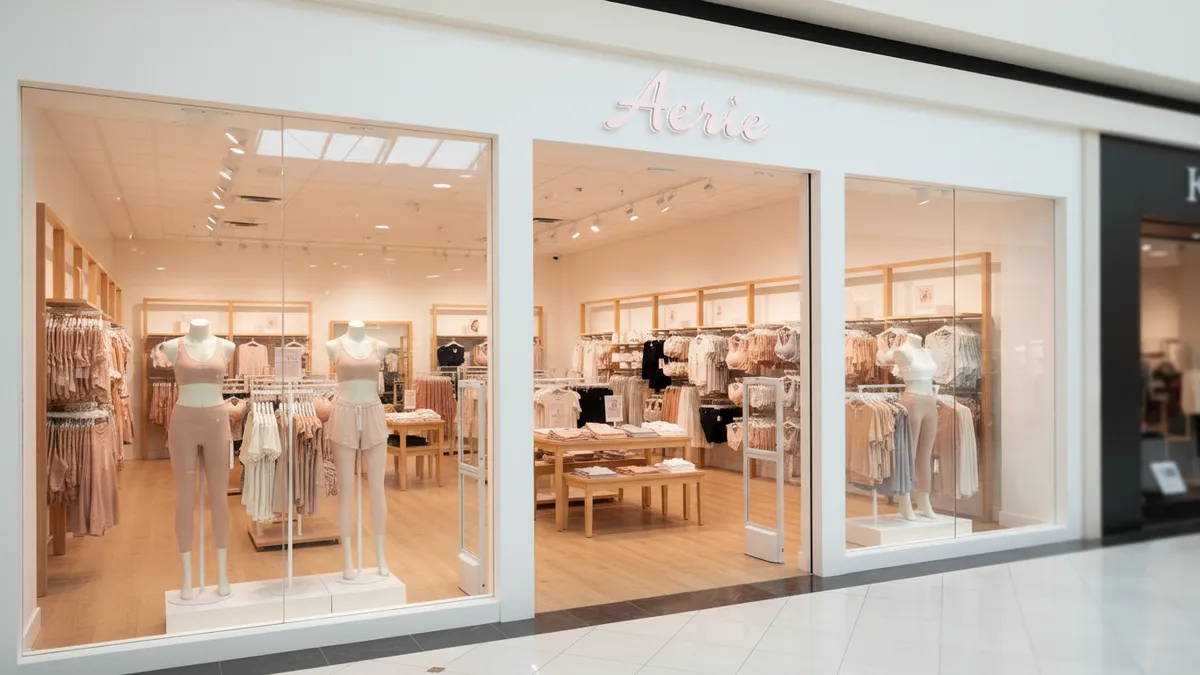
Aerie Delivers Record Quarter With 33% Revenue Jump
Aerie‘s $480.8 million quarter is the brand’s largest first-quarter haul on record. Comparable sales rose 25%, well ahead of TD Cowen analyst Jonna Kim’s pre-print model of roughly 19%. The brand also crossed a notable threshold: trailing 12-month revenue now exceeds $2 billion.
Growth was multichannel, with stores and digital both contributing. Aerie was launched in 2006 as an American Eagle subbrand focused on lingerie and loungewear, and has since expanded into swimwear, activewear under the OFFLINE label, and lifestyle apparel. It is now the growth engine of the AEO portfolio.
American Eagle Brand Reports Mixed Results
The flagship American Eagle brand generated $678.5 million in Q1, down 2.2% from a year earlier, with comparable sales off 2%. Women’s bottoms were the principal drag, with the company citing style and fit miscalibrations in the category. Cold spring weather across the U.S. added a further headwind to early-quarter traffic.
There were bright spots. The men’s business posted its third consecutive quarter of growth, and women’s tops performed in line with expectations. But the divergence between Aerie’s 25% comp gain and AE’s 2% decline frames a portfolio risk the company will need to address.
Total Company Beats Analyst Estimates on Revenue and Earnings
Total AEO revenue of $1.2 billion rose 10% and surpassed the analyst consensus of $1.18 billion. Net earnings swung to $23.5 million, a sharp reversal from a $64.9 million loss in Q1 2025. Earnings per share landed at 14 cents, ahead of the 11-cent consensus.
Operating income came in at $28 million, exceeding the company’s own March guidance range of $20 million to $25 million.
“This quarter reflected the strength of our portfolio and the power of Aerie. The brand achieved exceptional multichannel growth and profitability.” — Jay Schottenstein, Executive Chairman and CEO, American Eagle Outfitters
Inventory Build and Tariff Strategy Flag Caution
Inventory closed the quarter at $817 million, up 27% year-over-year, but unit inventory rose just 5%. The gap is the tell: AEO deliberately accelerated receipts and absorbed higher landed costs to front-run U.S. tariff deadlines. The strategy mirrors playbooks adopted across the apparel sector this spring.
SG&A expenses came in at $376 million, an 11% increase, driven largely by advertising spend supporting Aerie. Combined with the inventory build, the line items explain why a clear earnings beat was met with measured skepticism from analysts on the call.
Full-Year Guidance Held; Stock Declines After Hours
AEO reiterated its fiscal 2026 outlook: a mid-single-digit comparable sales gain and operating income of $390 million to $410 million. Management held the line despite the Q1 beat, signaling caution on second-half consumer demand and tariff pass-through.
The market response was punishing. AEO shares fell 12.9% to $15.61 in after-hours trading. The decline, despite the headline beat, reflects investor focus on the inventory dollar increase and the deceleration narrative around the AE brand rather than Aerie’s outperformance.
The reaction stands in contrast to the broader 2026 fashion earnings cycle, where Deckers Brands posted record $5.47B revenue in FY2026 on Hoka and Ugg momentum, and Ralph Lauren’s record $8B FY2026 revenue reinforced the strength of premium positioning. European houses also held up: Richemont’s €22.4B FY2026 revenue capped a resilient year for hard luxury.
Other mid-market and heritage names have also turned narratives this cycle. Burberry returned to profit in FY2026 after a strategic reset, while Capri Holdings’ Q4 results underscored ongoing pressure in the accessible-luxury segment. The U.S. retail landscape continues to consolidate, with Everlane’s sale to Shein and LVMH’s sale of Marc Jacobs to WHP Global reshaping ownership across the mid-tier.
The McKinsey State of Fashion 2026 report flagged mid-market softness and the rising premium on multichannel discipline — both visible in AEO’s quarter. For context on the resale dimension reshaping multichannel economics, see eBay’s 2026 luxury resale rankings.
AEO is scheduled to report Q2 fiscal 2026 results in late August.